DeFi Infrastructure Goes Agentic
In less than a year, AI agents went from writing code to shipping it. The same shift is now happening onchain. Agents discover DeFi services, pay for them, call them, and act on the results. Not in labs. In production.
That shift reshapes what onchain infrastructure has to look like. A stack designed for humans (dashboards, API keys, monthly invoices, support tickets) doesn't fit a world where the caller is an autonomous agent operating at machine speed and machine budgets. The infrastructure has to be callable, payable, and composable without a human in the loop.
KeeperHub has been building in that direction since before it had a name. Today, agentic DeFi isn't a demo. It's how the platform gets used.
Three things change when infrastructure is built for agents.
1. Infrastructure agents can call
The hardest part of agentic DeFi isn't the agent. It's the service the agent reaches for. Most onchain services weren't built to be called by code. They assume a user signs in through a browser, copies an API key into a dashboard, tops up a balance with a credit card, then checks a UI to see if the call worked.
That workflow doesn't fit an agent. Agents show up once, authenticate with a wallet signature, pay per call, and expect a machine-readable response.
KeeperHub workflows are built to be called this way. A user (or agent) builds a workflow, lists it on the Hub, and prices it per call in USDC. From that point, the workflow is a callable service with a stable endpoint, a JSON input schema, and a price. Any agent can discover it through the platform's OpenAPI document, pay via x402 on Base or MPP on Tempo, and receive a structured response. No accounts, no invoices, no support ticket.
What used to be a private automation is now a public micro-service. The same underlying workflow can be triggered by a cron job, a webhook, a human clicking Run, or an agent in a LangChain loop. The interface stays the same.
2. Infrastructure for building agent workflows
Agent workloads don't look like cloud functions. They're long-lived, multi-step, stateful, and expensive to get wrong. A failed transaction doesn't return a 500. It burns gas and leaves state half-updated.
The execution engine underneath KeeperHub was built for exactly this shape. Gas estimation adapts to network conditions with chain-specific safety buffers. Transactions retry with exponential backoff and reuse pending nonces instead of stacking duplicates. Private routing protects against MEV during volatile conditions. Every step is simulated, logged, and tied back to the original trigger with timestamps that survive a restart.
That engine is exposed through every surface an agent (or the developer behind it) might reach for:
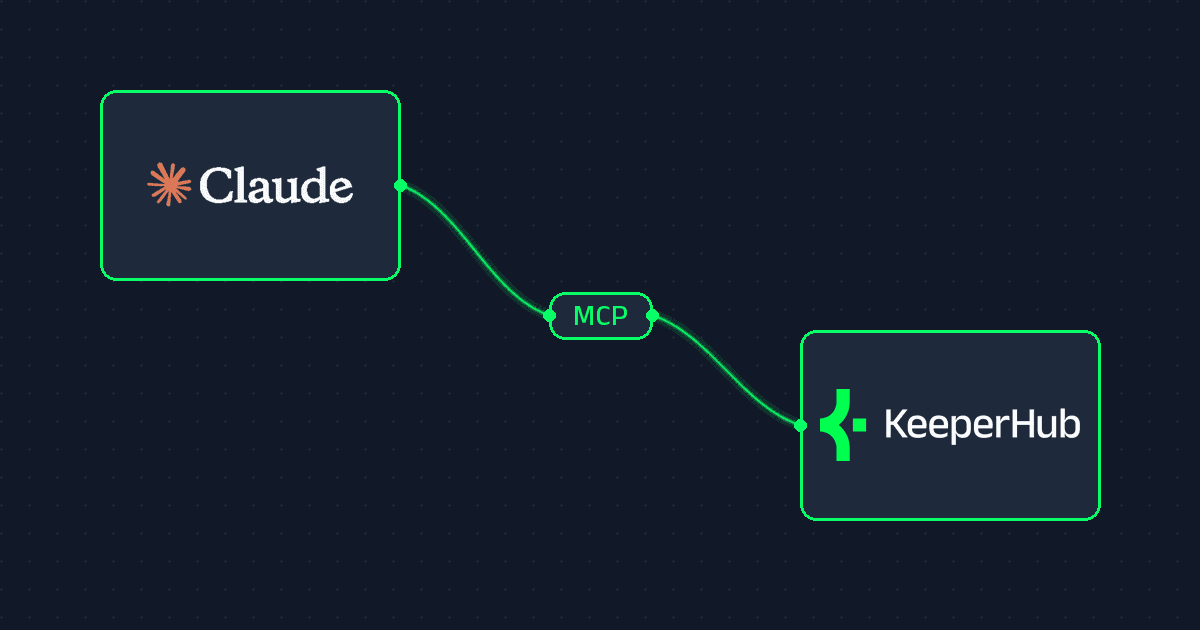
- MCP server with 19 tools covering workflow CRUD, execution, plugin discovery, and monitoring. Any MCP-compatible runtime wires in with one line.
- CLI for scripts, CI/CD pipelines, and custom agent runtimes.
- REST API for anything that speaks HTTP.
- x402 and MPP for pay-per-call execution, with native payment verification and receipts.
- Protocol plugins for Aave, Morpho, Uniswap, CoW Swap, Pendle, Sky, Ajna, and Safe, so agents aren't hand-rolling ABI calls.
- A plugin system for teams that want to ship their own nodes to the whole network.
The same workflow can be created in the visual builder, pulled through the API into a Git repo, extended through the MCP server, and called over x402. None of those paths change how it executes onchain. That unified surface is what keeps the agent's view of the world consistent with the engineer's.
3. DeFi infrastructure that is itself agentic
The last shift is the interesting one. Once the platform is callable by agents, you can start putting agents inside the platform.
KeeperHub's workflow builder already accepts natural language. Describe what you want, and an LLM generates the workflow: trigger, actions, conditions, all wired together and ready to review before it goes live. It runs locally inside the canvas or programmatically through the MCP server's ai_generate_workflow tool, which means another agent can be the caller.
Here's the loop that enables: a portfolio agent notices vault health drifting. It asks the MCP server to create a monitoring workflow with a Telegram alert at a 150% collateral ratio. The workflow is generated, reviewed by the user (or approved automatically under policy), and listed. Every execution, retry, and gas decision is logged and queryable by the same agent that created it. The agent isn't just using the infrastructure. It's shaping it.
That's what agentic DeFi infrastructure looks like in practice. The platform writes automations. Other agents call them. The audit trail keeps everyone honest about what happened.
Where this goes
Most of the industry conversation about agentic DeFi has been about the agents. Which models. Which frameworks. Which strategies. The more useful question is what those agents are calling.
If 2025 was the year agents started executing, 2026 is the year the execution layer has to grow up. Reliability guarantees, open payment rails, machine-readable discovery, native agent tooling: these stopped being optional somewhere along the way.
KeeperHub has been building that layer since before the agents arrived. Now we're watching people use it the way we hoped they would. Not as a human-operated control plane. As infrastructure that other software can lean on.